Blog / 7 min read · 2026-10-21
Gemini Made the Image Clearer—and Changed the Small Print: A Source-Checked Example
Compare a known source, a 300 × 200 input and one real Gemini web result. Inspect changed characters, fine lines, acquisition limits and a reproducible sampling example.
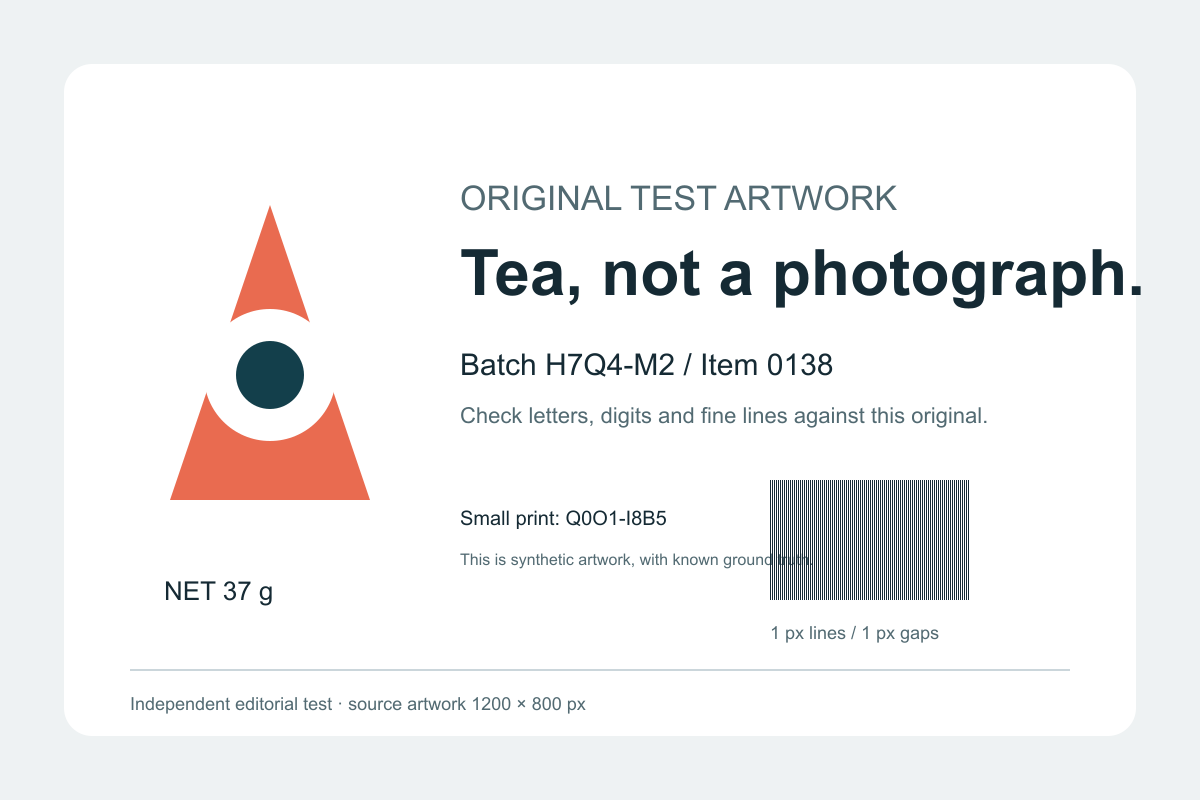
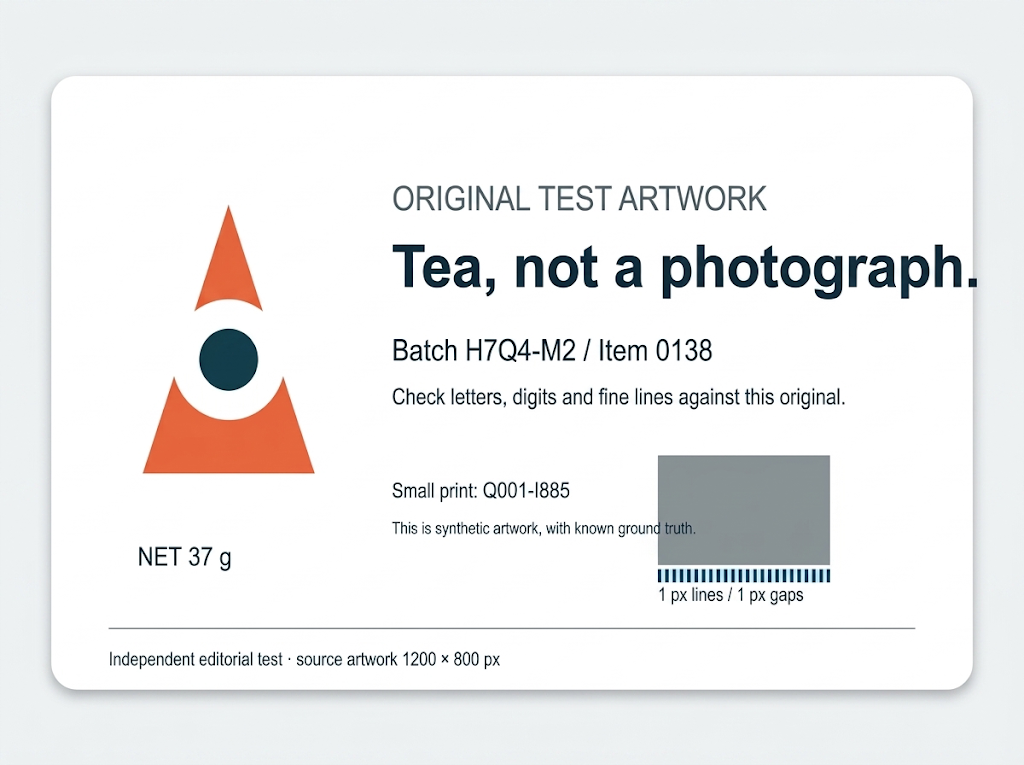
An image can look sharper without being more faithful to its source. In one controlled example, we gave Gemini a 300 × 200 version of our own test artwork and asked for a clear “4K” image. Its first result redrew small print and a fine-line pattern rather than preserving them exactly.
This is one documented example, not a failure rate. We kept the source artwork so the result could be checked against known text instead of judged only by appearance.
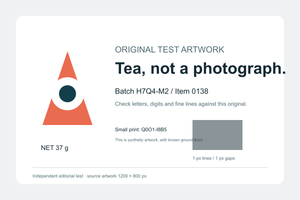
Known source
Actual first Gemini result
The two characters that changed
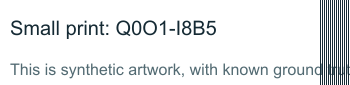
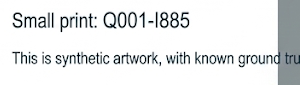
These are crops of the source and actual output, not retyped reconstructions. The layouts differ, so the crop coordinates differ. They are displayed at readable sizes, not used for a pixel-error metric.
The source says Q0O1-I8B5. The saved output reads Q001-I885: the letter O became zero, and B became 8. Cleaner-looking letter edges did not establish that the letters were correct.
What we actually tested
- We created an original 1200 × 800 SVG artwork containing known letters, numbers, and a one-pixel stripe pattern. No personal photographs were used.
- We reduced it to 300 × 200 using Lanczos3. Only this reduced image was uploaded; we did not give the model the high-resolution source or the correct characters separately.
- We used a new Gemini web conversation in the visible “Gemini Auto” mode. The exact underlying model version was not disclosed in that interface.
- We kept the first returned image, without selecting a favorable regeneration. The artifact was acquired through the site’s Copy image control and saved as PNG.
The exact submitted prompt was Chinese:
请直接编辑我上传的图片并输出一张图片:让这张图变成清晰的4K高清图,恢复小字和细线。保持原构图和内容,不需要解释。It asks for a clear 4K image, restored small text and lines, and an unchanged composition. This is a translation of the request, not an additional English test. The experiment was conducted on October 21, 2026 in New York time; evidence timestamps retain UTC.
A second, more constrained prompt was attempted, but its independent artifact did not pass our acquisition checks. It is excluded. This article does not establish that one prompt outperforms another.
What changed besides the text?
| Check | Known source | First saved output |
|---|---|---|
| Small print | Q0O1-I8B5 | Q001-I885 |
| Fine lines | One-pixel vertical lines throughout the block | Mostly a gray block, with a new row of coarse lines below |
| Presentation | Flat artwork | Added shadows and a raised-card appearance; a different aspect ratio |
| Dimensions | Source 1200 × 800; uploaded input 300 × 200 | Copied PNG 1024 × 765 |
We did not obtain the full-size download artifact. The copied PNG’s dimensions therefore cannot establish the service’s maximum resolution or prove that Gemini cannot produce 4K.
Gemini Apps Help documents editing and full-size downloading. The API documentation separately describes model and size configuration. An app control, an API setting, and the word “4K” in a prompt are not interchangeable evidence.
More pixels do not certify recovered details
Consider a reproducible example independent of Gemini. One original has vertical stripes; another has horizontal stripes. Averaging each 2 × 2 group reduces both to exactly the same gray pixels.
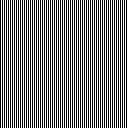
Vertical original
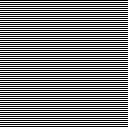
Horizontal original

Identical reduced pixels
We compared the reduced pixel buffers byte for byte: they are identical. That gray input alone cannot uniquely identify which original produced it. A plausible new texture is not the same thing as verified recovery.
This deliberately extreme synthetic example illustrates information loss. It does not prove that all photographs are beyond improvement or benchmark any image model.
A four-step check after editing
- Keep the original and its pixel dimensions. Avoid substituting a screenshot or messaging-app copy for the source.
- Inspect text, digits, logos, and faces against the original. Check important characters individually, not just the overall impression.
- Obtain the final file and inspect its properties. Do not infer its dimensions from “HD” or “4K” in a prompt.
- Match the edit to its use. A cosmetic change acceptable for a social image may be inappropriate for an archival label or a factual record.
A conservative editing request can say: “Improve lighting and mild noise only. Preserve composition, aspect ratio, text, digits, logos, and identity. Leave unreadable areas unchanged rather than inventing details.” This is suggested wording, not a remedy validated by our one documented result. Always inspect the output.
Materials and limitations
Source artwork · Actual uploaded input · First output artifact · Verification record · Sampling experiment.
One synthetic input and one archived first result cannot describe success rates, other models, every photo, or every Gemini entry point. The source, sampling illustration, ordinary resize, and model output are labeled separately. No other generator’s image is presented as a Gemini result.
The point is not to avoid AI editing: enjoy the visual improvement, then check whether it changed the facts too.